

Playing area
Formats of Cricket
Rules to Cricket Scoring System
Rules
Officials
Cricket rules
Cricket is a bat-and-ball game that is played between two teams of eleven players on a field, at the centre of which is a 22-yard (20-metre; 66-foot) pitch with a wicket at each end, each comprising two bails (small sticks) balanced on three stumps.
Two players from the batting team, the striker and nonstriker, stand in front of either wicket holding bats, while one player from the fielding team, the bowler, bowls the ball toward the striker's wicket from the opposite end of the pitch.
The striker's goal is to hit the bowled ball with the bat and then switch places with the nonstriker, with the batting team scoring one run for each of these swaps. Runs are also scored when the ball reaches the boundary of the field or when the ball is bowled illegally.
Playing area
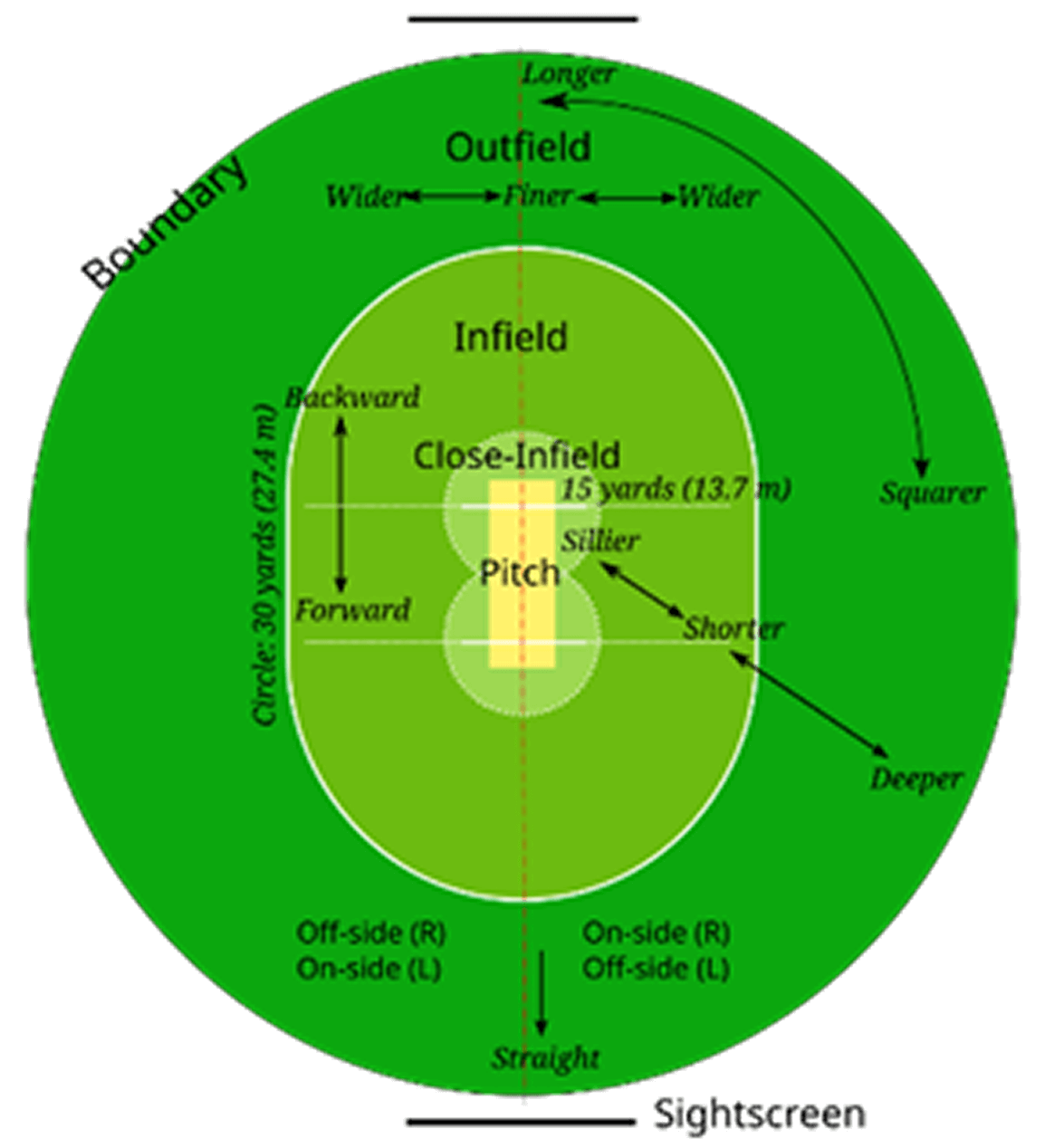
Cricket field is usually circular or oval in shape, and the edge of the playing area is marked by a boundary, which may be a fence, part of the stands, a rope, a painted line, or a combination of these; the boundary must if possible be marked along its entire length.
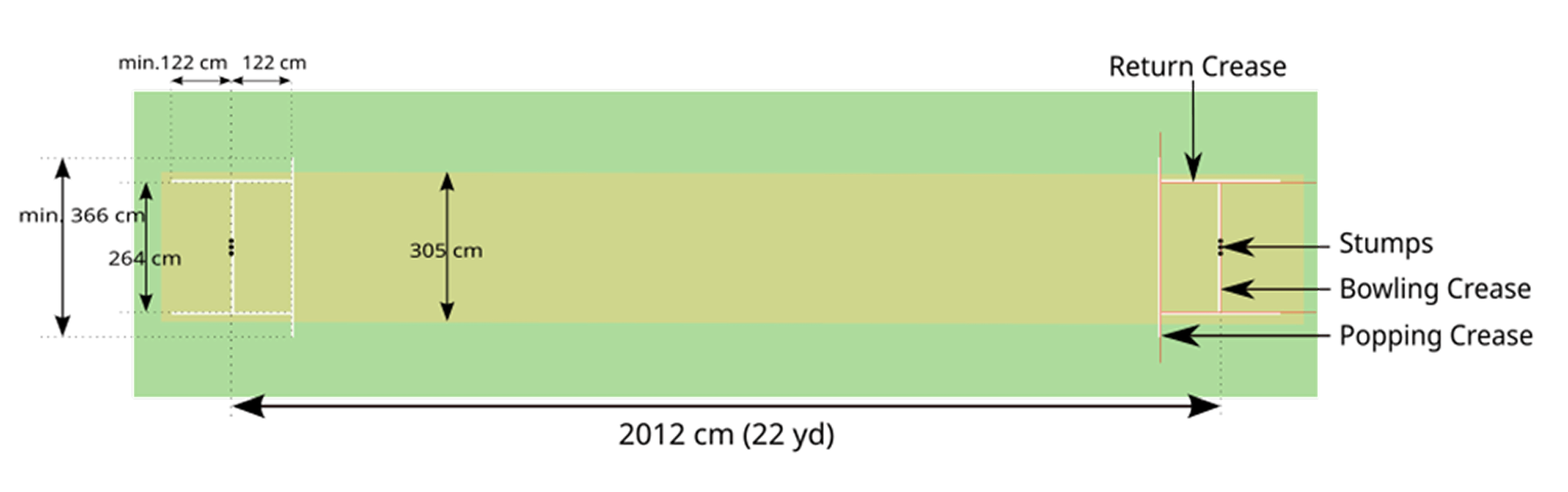
In the approximate centre of the field is a rectangular pitch on which a wooden target called a wicket is sited at each end; the wickets are placed 22 yards (20 m) apart. The pitch is a flat surface 10 feet (3.0 m) wide, with very short grass that tends to be worn away as the game progresses (cricket can also be played on artificial surfaces, notably matting). Each wicket is made of three wooden stumps topped by two bails.
Formats of Cricket
Test Matches
Played over five days
Each team bats twice (two innings per side)
Considered the purest and most traditional form of the game
Draws are common due to time limits
One Day Internationals (ODIs)
Each team bats for 50 overs
The team with the most runs after both innings wins
Matches last around 8 hours
Twenty20 (T20)
Each team bats for 20 overs
Matches last about 3 hours
Very fast-paced and beginner-friendly
T10 Cricket (T10)
Each team bats for 10 overs
Matches last about 90 minutes
Short format with intense action and entertainment
Rules to Cricket Scoring System
The aim for the batter in cricket is to try to score as many runs as possible throughout their innings. To score a run requires the batter to strike the ball and run to the opposite end of the pitch while their batting partner runs in the other direction. To record the scoring run, both batters need to touch the floor behind the popping crease with either their bat or body. In situations where the fielding team has not recovered the ball, the batters return back to score two or more runs. It is also possible to score runs without running the length of the pitch, if a batter can hit the ball past the boundary line (four runs) or over the line without bouncing (six runs). In addition to runs, there are other ways to add to the team's score. Extras. They are runs awarded for various indiscipline committed by the fielding team, such as wide balls, no-balls, byes, and leg byes. The score of a team is usually represented in the format of 'runs/wickets'. For example, if a team's score is 250/5, it means that they have scored 250 runs and lost 5 wickets. The first innings of a match set the target score for the second innings, and the team batting second must score more runs than the target to win.
Rules
The winning team in cricket is the side that scores the most runs, although in some situations a draw is recorded if they both get the same number of runs.
A cricket team consists of 11 players and they take it in turns to bat and bowl.
The bowler must not throw the ball, but bowl the ball overarm at the stumps, which are at either end of a 22-yard area called a wicket.
A batter is declared out if the bowler knocks off the bails of the stumps with a delivery.
A batter is declared out if a fielder or wicketkeeper catches the ball directly off the bat and before it hits the ground.
A batter is declared out if the umpire believes that the bowler's ball would have hit the stumps if the batter had not obstructed the ball with their pads. This is known as leg before wicket (or LBW).
A batter is declared run-out when they are going for a run but do not make the batting crease before fielding team knocks off the cricket stumps.
A batter is declared out if the wicketkeeper stumps them.
A batter is declared out if they knock over their stumps while playing a shot or avoiding a delivery.
There are other, less common ways of being out in cricket, but these are quite rare.
A batter is declared out if the umpire believes the batter has purposely obstructed a fielder who is about to take a catch or attempt a run-out.
The end of an innings is called when 10 of the 11 batting team are given out. At this point, both teams swap over. In competitive games, teams can have one or two innings.
Officials
During a competitive game of cricket there are two umpires officiating a match. An umpire is required to enforce the laws of the MCC by making decisions on:
no balls
byes
legs byes
wides
boundaries
One umpire is positioned behind the stumps at the bowler's end of the pitch and they make decisions on LBW (leg before wicket) appeals, no balls, wides and leg byes. The second umpire stands at square leg and they make decisions on stumpings and run outs. At the end of each over, the umpires change position.